
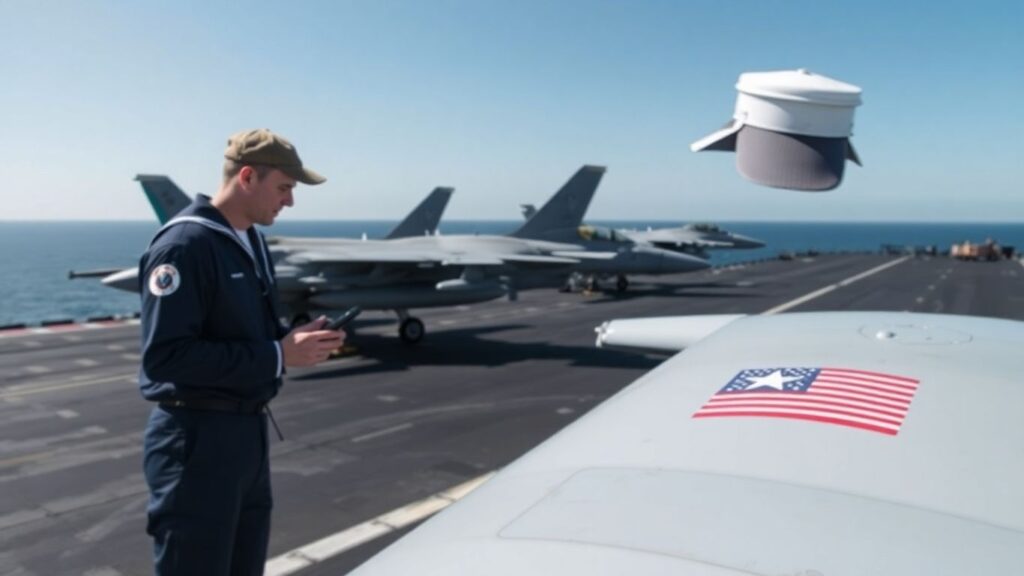
The U.S. Navy has successfully demonstrated a novel aircraft tagging system that utilizes QR codes and artificial intelligence to enhance the management of planes on flight lines. This innovative technology promises to streamline operations, reduce turnaround times for maintenance, and boost overall fleet readiness.
Key Takeaways
- The U.S. Navy is implementing a new system for tracking aircraft on flight lines.
- This system uses QR codes processed by AI and machine learning.
- It was developed by the Naval Air Warfare Center Aircraft Division (NAWCAD).
- The technology builds upon previous 5G experimentation for asset identification.
- The goal is to improve maintenance efficiency and operational readiness.
Advanced Aircraft Tracking
The new system, developed by the Naval Air Warfare Center Aircraft Division (NAWCAD) Lakehurst Digital Engineering team, employs a fixed camera setup. This camera autonomously registers aircraft taxi information by processing QR codes affixed to the planes. Artificial intelligence and machine learning algorithms then identify and track each aircraft at a given site.
During a recent trial, the U.S. Naval Test Pilot School and the NAWCAD Rapid Prototyping, Experimentation, and Demonstration (RPED) team successfully used the system to track T-6 Texan and T-38 Talon aircraft. This validation marks a significant step towards modernizing flight line operations.
Leveraging 5G Technology for Logistics
This aircraft tagging demonstration is an evolution of earlier experiments, including the 5G Identification of Support Equipment System (5GISE) conducted in January 2022. The 5GISE system utilized GPS to pinpoint the location of flight line assets, aiming to simplify support access and enhance logistics efficiency across naval aviation.
Kevin Larkins, Chief Engineer at NAWCAD Lakehurst, explained that after the 5GISE trial, engineers analyzed current aircraft tracking methods for departures and arrivals, leading to the development of this new QR code-based approach. The integration of 5G technology is central to creating a more connected and efficient operational environment.
Future Applications and Enhanced Readiness
Once fully implemented, the combination of 5GISE and the new QR code tagging system is expected to significantly decrease turnaround timelines for naval air fleet maintenance. This improvement is crucial for enhancing the readiness of the fleet.
The U.S. Navy envisions integrating this tagging information into various aspects of future flight line operations, including maintenance and overall operational management. NAWCAD RPED’s future concept includes incorporating this technology into a user interface for a next-generation flight line tracking system, further streamlining complex aviation processes.
Sources
- US Navy Demonstrates New Aircraft Tracking Capability Using QR Codes, The Defense Post.