
DataMatrix vs QR Codes: Choosing the Right Code
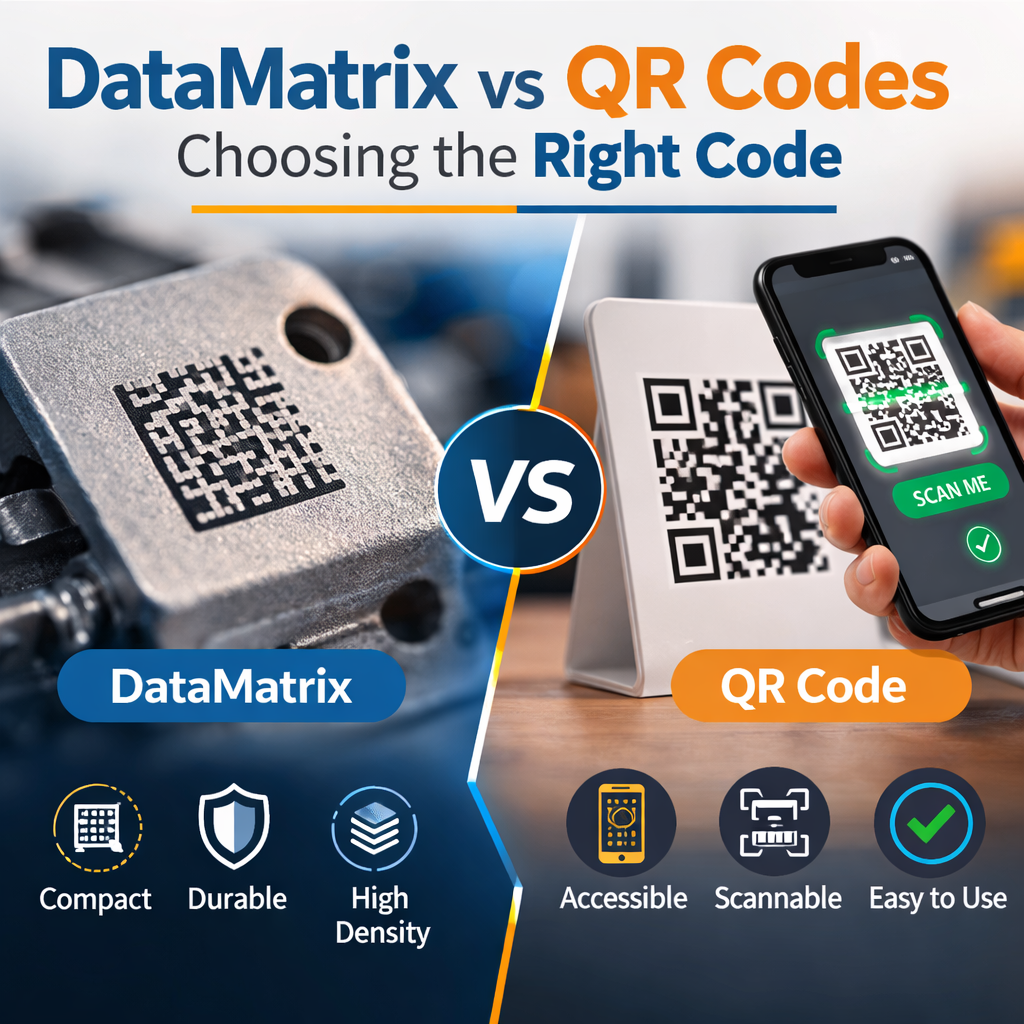
If you are comparing DataMatrix vs QR codes, the real question is not which one is “better” in the abstract. The real question is which code is better for the job you need it to do. DataMatrix is usually stronger where space is tight, traceability matters, and the code supports an operational workflow. QR is usually stronger where the goal is customer engagement, smartphone scanning, dynamic landing pages, and measurable campaigns.
This long-form UK guide explains how DataMatrix and QR codes work, where each one wins, how businesses across London, Greater London, and the wider United Kingdom should choose between them, and how scan tracking, analytics, and digital journeys differ between internal operations and customer-facing use cases.
💡 Short answer
Choose DataMatrix when you need compact, high-density operational labelling for traceability, manufacturing, healthcare, inventory, or asset control. Choose QR codes when you need easy smartphone scanning, branded customer engagement, dynamic destination updates, and campaign analytics. In many businesses, the smartest answer is not one or the other. It is both: DataMatrix for internal operational truth, QR for external customer interaction.
Quick facts: DataMatrix vs QR at a glance
- DataMatrix is usually smaller: it is often chosen where label space is limited and the code must still carry useful structured data.
- QR is usually easier for consumer engagement: smartphone cameras recognise QR codes more widely for web journeys, offers, menus, reviews, and forms.
- DataMatrix fits operations: it is common in traceability, manufacturing, healthcare, logistics, and asset workflows.
- QR fits marketing and service journeys: it is stronger for branded campaigns, dynamic links, and scan analytics.
- Many businesses need both: one code format for internal control, another for customer-facing action.
Complete guide: DataMatrix vs QR codes and how to choose the right one
1) What DataMatrix and QR codes actually are
Both DataMatrix and QR codes are 2D codes. Instead of using a single line of bars like a traditional barcode, they store data in two dimensions using a grid of dark and light modules. That lets them hold more information in less space than most linear codes.
They are similar in broad category, but they are not interchangeable in business practice. The design choice affects:
- how much space the code needs
- what kind of scanner or camera is likely to read it
- whether the code is meant for internal traceability or public interaction
- how easily the destination can be updated or tracked
- how natural the experience feels for staff or customers
If you want the internal product angle first, see Printed Data Matrix Code Stickers and our guide to the difference in Data Matrix codes and QR codes.
2) How DataMatrix works
A DataMatrix code is built for compact, high-density data storage. It can be square or rectangular and is often used where the available print area is small. That is why it appears so often on technical components, compact labels, healthcare items, warehouse tags, and asset stickers.
In business terms, DataMatrix is typically chosen when the code must support:
- serial numbers
- batch or lot references
- expiry data
- item-level identification
- traceability records
- small-surface labelling
It is a strong operational format. It is not usually the first choice for a public-facing poster, restaurant menu, or review journey, but it can still be used with web-compatible data where needed.
3) How QR codes work
A QR code is also a 2D code, but in modern business it is more strongly associated with smartphone-first interaction. The practical advantage is obvious: customers already recognise it, default phone cameras scan it easily, and the code naturally fits web links, booking flows, reviews, menus, forms, videos, support pages, and campaign landing pages.
For businesses, that means QR codes are often the better fit when the real goal is:
- driving a user to a web destination
- collecting reviews or enquiries
- updating a destination later with dynamic QR routing
- tracking scan performance by time, location, or placement
- making the action obvious to a customer with CTA text and branding
For a broader business implementation angle, see How Businesses Use Printed QR Code Labels and QR Code Stickers UK: How Businesses Order Custom QR Labels.
4) The core difference: operational traceability vs customer interaction
This is the comparison that matters most. In many real business environments, the choice becomes simple once you ask one question:
Is this code mainly for internal operations, or is it mainly for human interaction through a phone?
- If it is mainly for internal operations: DataMatrix is often the stronger candidate.
- If it is mainly for public interaction: QR is often the stronger candidate.
That distinction matters because the same business may need both. A warehouse team might use DataMatrix for compact inventory labels while the same company uses QR codes on packaging, vans, showroom displays, or support cards to drive customers into digital journeys.
5) Where DataMatrix usually wins
DataMatrix tends to be the better choice when space is constrained or the workflow is technical. It is especially strong in:
- manufacturing part marking
- pharmaceutical and healthcare traceability
- warehouse and inventory labels
- asset tags for service, FM, and equipment control
- small products or components where a larger QR code would be inefficient
The business benefit is not aesthetic. It is operational: you get dense information in a small symbol and a better fit for traceability-heavy workflows.
6) Where QR usually wins
QR codes usually win when the code is meant to be scanned by ordinary people on ordinary phones. That makes them the better fit for:
- menus and ordering
- Google reviews and feedback journeys
- offers, vouchers, and event campaigns
- booking forms and contact actions
- product pages, setup guides, or support content
- dynamic destinations that need to be changed without reprinting
This is also where driving engagement and tracking scans becomes commercially important. QR codes are commonly paired with dynamic redirects, campaign analytics, and location-based comparisons. That makes them a natural fit for businesses trying to measure what happens after the scan, not just whether the code exists.
7) Scan tracking: where the commercial difference shows up
Businesses often compare DataMatrix and QR as if the only issue is code shape. That misses the bigger point. The more useful distinction is what happens after the scan.
With customer-facing QR campaigns, businesses can often track:
- scan count
- time of scan
- approximate location
- which poster, table, counter, window, or van performed best
- which CTA or landing page converted better
With DataMatrix-led operational workflows, the value usually looks different:
- which asset was scanned
- by whom or at which stage
- which batch, item, or service point was handled
- whether a maintenance or inventory event was completed
- how the asset or item moved through the workflow
So both can support tracking. The difference is the type of tracking. QR usually supports engagement analytics. DataMatrix usually supports operational traceability.
8) Business benefits of choosing correctly
Choosing the right code saves more than design effort. It affects conversion, efficiency, and the cost of fixing bad decisions later.
The benefits of choosing well include:
- better scan reliability for the intended user
- better fit for the available label size
- cleaner data capture and fewer manual errors
- better customer confidence and higher scan motivation
- stronger campaign analytics or operational visibility
- less rework caused by the wrong format, wrong surface, or wrong workflow design
This is why the right code choice is not a design preference. It is a systems decision.
9) Investigative view: what businesses often get wrong
When businesses choose badly, the pattern is usually predictable.
- They choose QR for everything: even when the label is tiny and the real need is item-level traceability.
- They choose DataMatrix for customer interaction: even when the whole point is easy smartphone engagement.
- They focus on print before workflow: the code gets designed before the business defines what the scan should actually do.
- They ignore environment: reflective finishes, wrong substrates, or poor contrast hurt scannability regardless of code type.
- They assume one code can solve every job: in practice, mixed systems often work better.
The better question is never “Which code looks more modern?” It is “Which code creates the least friction for the person or system that needs to scan it?”
10) Local examples: London, Greater London, and UK scenarios
These local examples make the choice clearer.
- Soho restaurant: QR code wins. The code is customer-facing, scanned with phones, linked to menus, offers, reviews, and repeat-visit campaigns. Dynamic routing helps the business update destinations without reprinting.
- Canary Wharf office facilities team: DataMatrix often wins for compact asset and inspection labels on plant, access points, service points, and maintenance-critical equipment where scan history matters more than customer experience.
- Croydon warehouse: DataMatrix often wins on tight bin and component labels where traceability, batch handling, and compact size matter. QR may still be used on outer cartons or training signage.
- Camden retailer: QR wins for customer journeys on shelf talkers, packaging inserts, and review requests. DataMatrix may still be used behind the scenes for inventory control or refurb workflows.
- Greater London engineering contractor: mixed use wins. DataMatrix for internal serialised parts, QR for service reports, manuals, call-out forms, and client-facing documentation access.
- UK healthcare supplier: DataMatrix leads for product traceability and compact identification, while QR may support outer-pack education, instructions, or public-facing digital information where appropriate.
In short, London service and hospitality environments usually lean harder into QR. London technical, warehouse, healthcare, and engineering workflows usually lean harder into DataMatrix. Hybrid operations often need both.
11) Dedicated examples section: which code should each business choose?
Here is the practical version.
- Café chain in London: choose QR for menus, offers, loyalty, reviews, and window conversions.
- Medical supplier in Greater London: choose DataMatrix for compact product identification and serial-level traceability.
- Retail brand with packaging campaigns: choose QR for scan-to-video, scan-to-register, support guides, and review journeys.
- Warehouse with small part bins: choose DataMatrix where dense item data and compact labels matter.
- Facilities management company: choose DataMatrix or QR depending on scan device and workflow. If technicians use managed scanners and compact labels are needed, DataMatrix may be better. If the code must open phone-friendly service pages, QR may be better.
- Multi-site business with customer and back-end needs: use DataMatrix internally and QR externally.
That final example is the one most businesses underestimate. There is no rule saying one symbology must do everything.
12) YouTube video example: practical comparison of QR, Data Matrix, and barcode use
This video is a good fit because it compares QR code, Data Matrix code, and barcode usage in practical business terms, including where each format fits and why that choice matters. That makes it more useful than a generic “how to generate a code” video.
13) Advanced use cases: when both formats belong in the same system
The smartest businesses do not argue about formats in the abstract. They design a system in which each format does the job it is best at.
- Manufacturing + aftercare: DataMatrix on the part, QR on the documentation pack.
- Warehouse + customer fulfilment: DataMatrix for stock control, QR on packaging for support and reorder journeys.
- Facilities management: DataMatrix on compact plant labels, QR on service doors or public interfaces where smartphone access is expected.
- Healthcare + patient information: DataMatrix for regulated traceability, QR for web-based instructions and patient-friendly digital content.
- Retail + refurb operations: DataMatrix for internal refurbishment and returns handling, QR for product education and reviews.
This is where Search Everywhere thinking becomes commercially useful. You are not just choosing a label. You are choosing how physical things connect to digital actions, how those actions get measured, and how easily an AI system, a search engine, or a human user can understand the pathway.
14) Internal and external reading worth linking to
Internal resources that support this topic include Difference in Data Matrix Codes and QR Codes, Printed Data Matrix Code Stickers, Optimising Your Warehouse: Essential Tips for Effective Inventory Labelling, QR Code Inventory Stickers, QR Code Asset Stickers, and Facilities Management QR Code Stickers.
For external context, useful references include GS1 guidance on the differences between GS1 DataMatrix, Data Matrix with GS1 Digital Link, and QR Code with GS1 Digital Link, GS1 Sweden’s explanation of which 2D code suits consumer engagement vs compact traceability, and a recent comparison guide here: Data Matrix vs. QR Codes: Overview and Key Differences.
15) Quote: Simon King (Head of Sales)
“When businesses ask whether DataMatrix or QR is the right code, the honest answer is usually hidden in the workflow. If the scan is about compact traceability and operational control, DataMatrix often makes more sense. If the scan is about getting a person to act on a phone, QR usually wins. The mistake is trying to force one code to do both jobs badly.”
— Simon King, Head of Sales
Conclusion: choose the code that removes the most friction
The best way to choose between DataMatrix and QR codes is to start with the user, the device, the space available, and the job the scan needs to do. DataMatrix is usually the stronger choice for compact traceability, operational visibility, and internal control. QR is usually the stronger choice for public-facing interaction, dynamic web journeys, and campaign analytics.
For businesses across London, Greater London, and the UK, the strongest setups are often hybrid. Use DataMatrix where precision, density, and workflow tracking matter. Use QR where you want easy smartphone engagement, brand confidence, and measurable customer action. Choose the code that removes the most friction from the real journey, and the result is not just better scanning. It is better business performance.
FAQs
What is the main difference between DataMatrix and QR codes?−
DataMatrix is usually better for compact operational labelling and traceability, while QR is usually better for customer-facing smartphone journeys such as menus, offers, reviews, forms, and dynamic landing pages.
Which code is better for businesses?+
It depends on the use case. DataMatrix is often better for internal workflows, small labels, and high-density identifiers. QR is often better for branded engagement, web links, and measuring customer interaction after the scan.
Can DataMatrix codes be used for web links?+
Yes, they can be used with web-compatible formats, but QR codes are generally the more natural and more widely recognised choice for public web engagement because smartphone cameras handle them more easily.
Can both DataMatrix and QR codes support tracking?+
Yes. QR codes are commonly used for engagement analytics such as scan count and campaign performance. DataMatrix codes are more often used for operational tracking such as asset history, inventory events, service records, and traceability checkpoints.
Should my business use both formats together?+
Often yes. Many businesses use DataMatrix for internal traceability and QR for customer engagement, support content, marketing journeys, and other smartphone-first interactions.
Speak to Us Today
Need help deciding whether your workflow needs DataMatrix, QR, or a hybrid setup? Speak directly to Simon by calling 01403 801000.
You can also reach us via WhatsApp from the link in the site header, or use our AI-powered support chat in the bottom-right corner for instant answers.