Why Data Matrix Asset Labels Matter for Modern Asset Tracking
If you need stronger asset identification, better scan reliability, and cleaner control over equipment, devices, tools, and fixed assets, Data Matrix asset labels are often one of the most practical choices. They matter because they help businesses label more intelligently where space is tight, where durability matters, and where every asset needs a unique machine-readable identity.
This guide explains why Data Matrix asset labels matter for modern asset tracking, how they work, why they are often chosen over simpler label formats, and how organisations across London, Greater London, and the wider United Kingdom use them for fixed asset control, maintenance records, audit support, healthcare equipment, IT estates, manufacturing assets, warehouse tools, and multi-site operational tracking.
💡 Short answer
Data Matrix asset labels matter because they give each asset a compact, durable, and highly scannable identity that links physical equipment to digital records. They help businesses track assets more accurately, support maintenance and audit workflows, reduce manual errors, and label even small items where a larger barcode or a text-heavy label would be impractical.
Quick facts: Data Matrix asset labels at a glance
- They are compact: Data Matrix codes can carry useful identification data in a very small footprint, which makes them well suited to small equipment, devices, and components.
- They are operationally strong: they work well where assets need unique identification, scan-based lookup, service history, or traceability in a wider database or asset register.
- They reduce manual friction: scanning a label is faster and more accurate than typing long serial numbers, internal references, or location records by hand.
- They support durability-focused label design: material, adhesive, laminate, and print quality can be matched to offices, warehouses, healthcare environments, workshops, or field conditions.
- They fit modern tracking systems: Data Matrix labels are often used alongside asset registers, maintenance software, and audit workflows.
Complete guide: why Data Matrix asset labels matter for modern asset tracking
1) What a Data Matrix asset label actually does
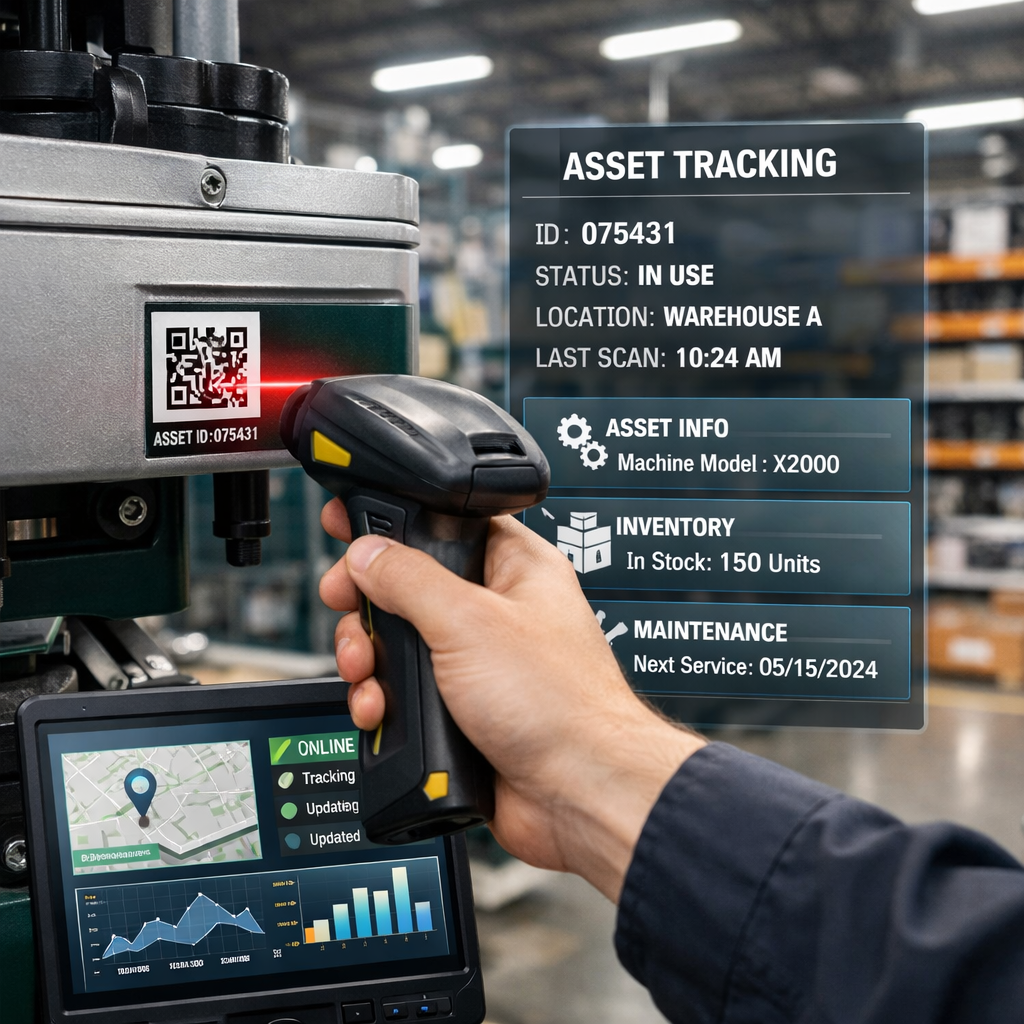
A Data Matrix asset label gives an individual asset a machine-readable identity that can be scanned quickly and linked to a digital record. That record might hold a simple internal asset number, or it might connect to richer data such as purchase history, assigned user, service dates, inspection status, location history, warranty details, or disposal records.
In practical business terms, the label is not just there to “mark” an asset. It acts as the working bridge between the physical item and the system used to manage it. That is why Data Matrix matters in modern tracking. Businesses do not just need to know that an asset exists. They need to know which asset it is, where it is, who has it, what condition it is in, and what needs to happen next.
2) Why modern asset tracking needs better labels, not just better software
A surprising number of asset tracking problems start at the label layer. Software can only work well if the asset can be identified consistently. If labels are too large, too fragile, too generic, or too difficult to scan in real conditions, the whole workflow becomes weaker.
That is one reason Data Matrix asset labels matter. They help close the gap between the asset management system and the reality of the environment. A compact code that scans cleanly on a laptop, handheld device, medical unit, tool body, storage tote, or equipment casing is often more useful than a bigger label that takes up too much space or becomes impractical to apply.
3) The main reason businesses choose Data Matrix for assets: more identity in less space
One of the strongest advantages of Data Matrix is that it can encode useful information in a very small area. That matters for asset tracking because many items do not have much room for labelling. Think of tablets, scanners, small tools, test devices, electronic components, lab equipment, or tightly packed industrial assemblies.
In these cases, a compact code is not a cosmetic preference. It is what makes machine-readable identification possible at all. Where a linear barcode may need more width, a Data Matrix symbol can often fit more comfortably on the asset while still supporting fast lookup.
4) Why Data Matrix asset labels matter for accuracy and speed
Manual asset processes are expensive in ways that are easy to underestimate. Typing serial numbers by hand slows staff down. Reading worn labels creates mistakes. Re-keying references during audits, maintenance checks, stocktakes, or transfers introduces avoidable error.
Data Matrix asset labels help because one scan can pull up the correct record immediately. That improves:
- asset issue and return processes
- location changes and transfers
- maintenance checks and inspection logs
- fixed asset audits and reconciliation work
- service history updates
- end-of-life or disposal tracking
The gain is not just speed. It is cleaner data. Better scans usually mean fewer duplicate records, fewer unknown items, and less confusion over which asset is which.
5) Why Data Matrix is commercially useful for fixed asset control
Modern asset tracking is not only about operational neatness. It affects cost control, accountability, compliance support, and replacement planning. When businesses lose visibility over assets, they often overbuy, under-maintain, or fail to recover equipment that is already on the books.
Data Matrix asset labels matter because they support a stronger control layer. Each label can point to a unique record, which makes it easier to answer commercially important questions such as:
- How many assets of this type do we actually have?
- Which site or team has them now?
- Which units are due for service or inspection?
- Which items are missing, retired, or duplicated in the system?
- Which assets are still active and worth maintaining?
That is where label strategy becomes financially relevant. Better identification usually leads to better decisions.
6) Why Data Matrix asset labels matter in durability-heavy environments
A code is only useful if it remains readable in the real environment. Offices may seem easy, but even there labels face repeated handling, cleaning, cable movement, and routine wear. In warehouses, workshops, healthcare settings, and field operations, the pressures are greater.
Depending on the application, asset labels may need to handle:
- frequent wiping or cleaning
- abrasion and repeated contact
- oils, chemicals, or disinfectants
- heat, cold, or humidity
- outdoor or semi-outdoor exposure
- long service life on capital equipment
Data Matrix is a strong fit here because it is commonly used in operational settings where compact, durable identification matters. The label stock, adhesive, laminate, and print specification still need to be chosen correctly, but the symbol itself is well aligned with demanding tracking use cases.
7) Why Data Matrix asset labels matter for maintenance, service, and audit workflows
Asset tracking is much stronger when the label supports more than one event. A good Data Matrix label can be scanned during issue, return, inspection, cleaning, service, calibration, movement, and disposal. That means the same asset identity can travel through the full operational life of the item.
For maintenance-heavy organisations, this matters because the label becomes a repeatable checkpoint. Staff can scan the same asset every time work is done, which helps build a cleaner service history and reduces uncertainty around who touched the asset, when it was checked, and what happened next.
8) Why Data Matrix matters where standards-based identification is important
In some environments, businesses do not just want an internal label. They want a more structured identification approach that aligns with broader standards. Data Matrix can support this, including use cases that connect to a Global Individual Asset Identifier (GIAI) or other structured data models where each asset needs a globally unique identity.
This matters for organisations that want their asset labels to do more than hold a short internal code. A standards-based format can support consistency across locations, systems, suppliers, and long-term operational changes. For some organisations, that becomes particularly valuable in healthcare, government-related environments, large IT estates, and complex multi-site operations.
9) Investigative view: what most businesses get wrong about asset labels
The biggest weakness in many asset tracking projects is not the software. It is the assumption that any label will do.
- They choose a label that is too large: it fits awkwardly or fails on smaller assets.
- They use labels with no durable specification: which leads to early wear and scan failure.
- They label without a clean database structure: so the scan opens poor records or inconsistent fields.
- They rely on visible text alone: which slows audits and increases manual error.
- They treat all assets the same: even though laptops, field tools, medical devices, and workshop equipment often need different label constructions.
A weak asset label strategy causes problems quietly. The system appears to exist, but the records become unreliable because the identification layer was never strong enough.
10) London and UK examples: where Data Matrix asset labels create practical value
These examples show where the value becomes clear.
- London university IT department: compact Data Matrix labels on laptops, tablets, monitors, and AV equipment make room-limited assets easier to issue, recover, and audit.
- Greater London healthcare provider: labels on mobile devices, diagnostic units, and reusable equipment support faster lookup, service control, and clearer equipment history.
- Heathrow-area logistics operation: Data Matrix labels on scanners, cages, and handling equipment improve internal identification where assets move between teams and sites.
- Croydon facilities team: plant room equipment, handheld tools, and service assets are linked to inspection records and maintenance schedules.
- Midlands manufacturer supplying London sites: small labels on tools, fixtures, gauges, and repairable components improve traceability without taking up too much surface area.
- Multi-site field service business: engineers scan Data Matrix labels to confirm which asset was serviced, replaced, or transferred during each visit.
11) Where Data Matrix asset labels usually outperform simpler label approaches
Data Matrix is not automatically the right answer for every job, but it is often the better choice when one or more of the following is true:
- the asset is small
- the label needs to stay compact
- the code must link to a unique record
- the asset will be scanned repeatedly over time
- the business needs stronger traceability
- durability and long-term readability matter
- the tracking model needs a structured data approach
That is why Data Matrix is so common in industries that care about item-level identification, service records, serialised assets, or space-constrained labelling.
12) YouTube video example: asset tracking in a warehouse environment
This video is a better fit for the updated page because it focuses on warehouse asset and inventory visibility, which aligns more closely with the operational asset-tracking angle behind this guide.
13) Advanced use cases: beyond basic asset labelling
The strongest Data Matrix asset label systems go beyond “scan for ID”.
- database-linked fixed asset records: one scan opens the full asset profile.
- maintenance and calibration control: the label acts as the gateway to inspection and service history.
- chain-of-custody workflows: users can record issue, return, handover, or transfer events against the asset.
- mixed-format environments: businesses can use Data Matrix on small or dense assets while using other codes elsewhere in the estate.
- standards-based asset identification: where organisations want a more structured numbering framework, including GIAI-style approaches.
- audit compression: stocktakes and asset checks become faster because staff scan instead of manually reconciling long lists.
This is where the label stops being a sticker and becomes part of the control system behind the asset.
14) Internal and external reading worth linking to
Internal resources worth linking to include Printed Data Matrix Code Stickers, DataMatrix Codes: A Complete Guide, DataMatrix vs QR Codes: Choosing the Right Code, 5 Best Practices for DataMatrix Codes, and Data Matrix QR Code Stickers for IT Services & Data Centres.
For external context, useful references include the GS1 DataMatrix Guideline, the GS1 UK page on asset management, and the GS1 US guide to the Global Individual Asset Identifier (GIAI).
15) Quote: Simon King (Head of Sales)
“The real value of a Data Matrix asset label is not the symbol on the surface. It is the certainty behind the scan. When each asset has a compact, durable identity that links to the right record, the whole tracking system becomes faster, cleaner, and easier to trust.”
— Simon King, Head of Sales
Conclusion: Data Matrix asset labels make asset tracking more accurate, durable, and operationally useful
Data Matrix asset labels matter because they help businesses identify and manage physical assets with more accuracy in less space. They support faster scanning, cleaner records, better maintenance visibility, and stronger control over equipment across its working life.
For organisations across London, Greater London, and the UK, the value is practical. Data Matrix asset labels can improve fixed asset registers, maintenance workflows, internal accountability, audit readiness, and the day-to-day usability of asset tracking systems. They are especially valuable where assets are small, mobile, high-volume, or expected to stay in service for years.
The biggest gain is not simply that the asset is labelled. It is that the label creates a dependable link between the item and the system behind it. That is why Data Matrix remains such a strong choice for modern asset tracking.
FAQs
Why are Data Matrix asset labels used for asset tracking?−
They are used because they give each asset a compact machine-readable identity that supports faster scanning, better database lookup, improved traceability, and fewer manual errors.
What is the difference between a Data Matrix asset label and a standard barcode label?+
Data Matrix is a 2D code that can hold useful identification data in a smaller footprint than a standard linear barcode, which makes it a stronger fit for small assets and structured tracking workflows.
Can Data Matrix asset labels support fixed asset registers and maintenance systems?+
Yes. They are often linked to asset registers, maintenance platforms, service records, inspection logs, and audit workflows so each scan opens the right asset history.
Are Data Matrix asset labels suitable for small equipment and IT assets?+
Yes. They are often well suited to laptops, tablets, handheld devices, tools, lab equipment, and other assets where the available label space is limited.
Which UK organisations benefit most from Data Matrix asset labels?+
Healthcare providers, manufacturers, warehouses, universities, councils, laboratories, logistics firms, and multi-site service businesses often benefit most because they need more reliable identification and cleaner asset control.
Speak to Us Today
Need help choosing the right Data Matrix asset labels for small equipment, IT assets, tools, fixed asset registers, or maintenance workflows? Speak directly to Simon by calling 01403 801000.
You can also reach us via WhatsApp from the link in the site header, or use our AI-powered support chat in the bottom-right corner for instant answers.